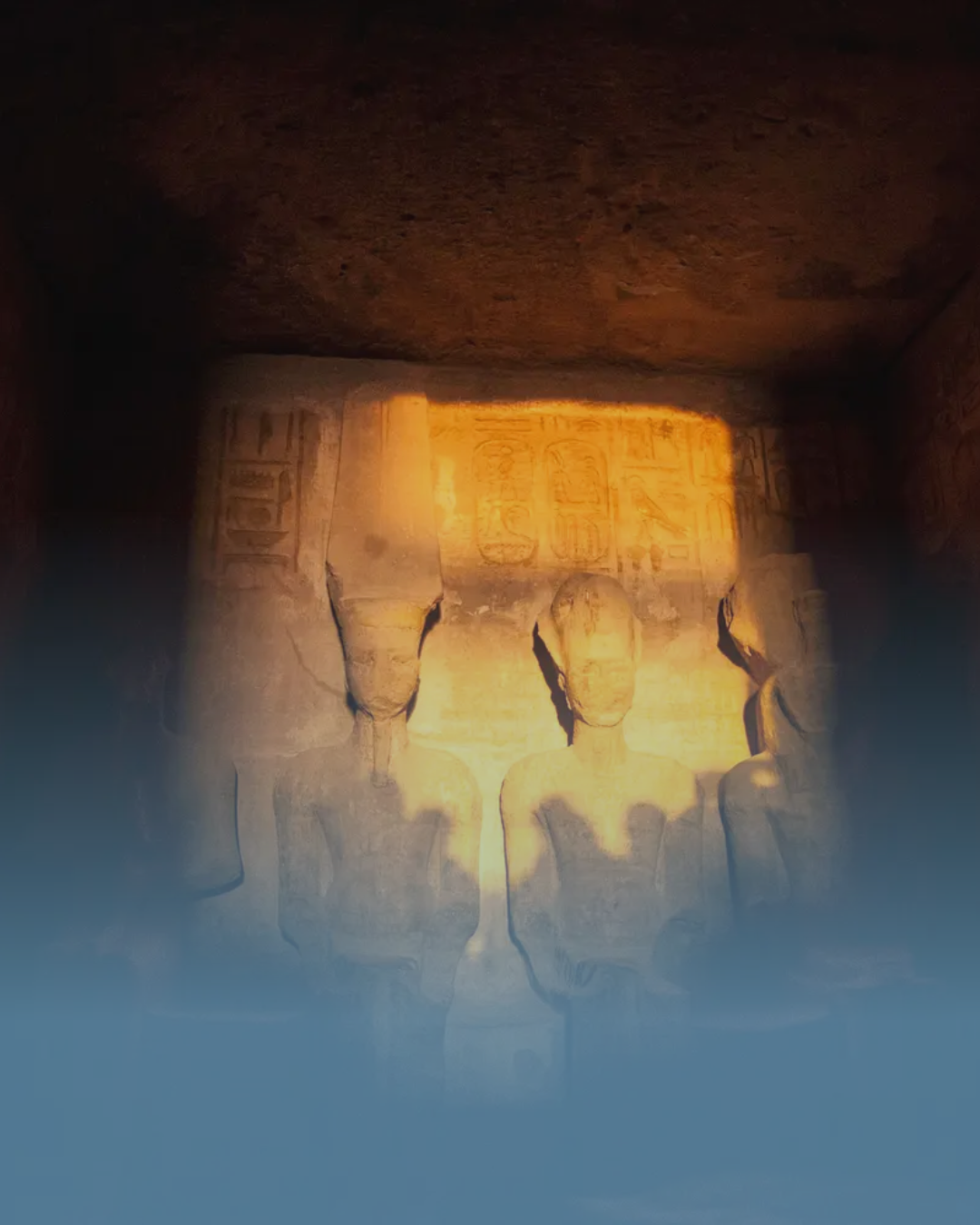
February 22 — Abu Simbel: The sun aligned with the face of King Ramses II’s statue at the Great Temple of Abu Simbel on Sunday, February 22, 2026, in a rare astronomical event that occurs only twice each year.
The phenomenon began at 6:22 a.m. and continued for approximately 22 minutes, ending at 6:44 a.m. It takes place annually on February 22 and October 22 and is considered one of Egypt’s most remarkable historical and astronomical events.
Fahmy El Amin, Director General of the Department of Egyptian, Greek, and Roman Antiquities in Aswan, said the solar alignment tradition dates back more than 3,300 years, reflecting the advanced scientific and engineering knowledge of ancient Egypt.
The event drew attendance from government officials, representatives from the ministries of antiquities, tourism, and culture, and local authorities from Aswan. Around 2,000 Egyptian and international visitors gathered at the site to witness the phenomenon in person, while millions more followed the event through television broadcasts and global media coverage.
Ahmed Massoud, Director of the Abu Simbel antiquities area, said the solar alignment demonstrates the extraordinary skill of ancient Egyptian builders, who combined architecture, astronomy, engineering, and artistic design in the construction of the temple.
He described the alignment as one of Egypt’s most significant astronomical events, attracting tourists, researchers, and photographers from around the world. The phenomenon highlights how ancient Egyptians linked celestial movements with religious and agricultural significance.
The alignment occurs at sunrise, when sunlight enters the temple and passes through its corridors and chambers, eventually reaching the inner sanctuary. The rays illuminate the face of Ramses II’s statue, which stands within the temple structure rising more than 60 meters.
As the sunlight intensifies, it also illuminates statues of the gods Amun and Ra-Horakhty inside the sanctuary. However, the light does not reach the statue of the god Ptah, who was associated with darkness in ancient Egyptian belief.
Massoud noted that this precise alignment reflects the ancient Egyptians’ symbolic association between Ramses II and Ra, the sun god, further demonstrating the religious and scientific significance of the temple’s design.