February 8 — Cairo: Egypt has introduced its first national Startup Charter, backed by a $1 billion funding plan and a series of policy reforms aimed at strengthening innovation, creating employment opportunities, and supporting economic growth.
According to an official Cabinet statement, the initiative follows more than a year of consultations involving 15 government institutions and over 250 participants, including entrepreneurs, startup founders, ecosystem experts, and parliamentary representatives.
The charter is expected to support approximately 5,000 startups, create around 500,000 direct and indirect jobs, and help Egyptian startups expand into international markets, according to the Ministerial Group for Entrepreneurship.
Egypt’s startup sector has seen significant growth in recent years. During the first five months of 2025 alone, startups secured $228 million in venture capital and debt financing, reflecting a sharp increase compared to previous periods. Official data also showed that total startup funding reached $614 million in 2025, highlighting rising investor confidence and the expansion of financing opportunities.
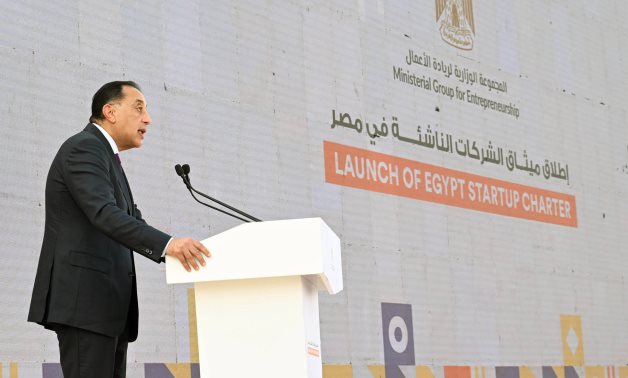
The official launch event took place on February 7 at the Grand Egyptian Museum, with Prime Minister Mostafa Madbouly and Minister of Planning and Economic Development Rania Al-Mashat in attendance. The event also included members of the ministerial entrepreneurship group, the governor of Giza, foreign ambassadors, and representatives from venture capital firms and the startup community.
In its statement, the Cabinet described the Startup Charter as a strategic framework designed to strengthen the startup ecosystem, encourage innovation-driven growth, and enhance economic competitiveness while contributing to job creation.
The charter outlines several key priorities over the next five years, including supporting startups in expanding internationally, developing local talent to reduce brain drain, encouraging venture capital investment, and attracting funding through a coordinated national financing initiative. It also aims to connect startups with major economic and social challenges, enabling innovative solutions across multiple sectors.
Speaking at the launch, Minister Al-Mashat emphasized that the charter is intended to serve as a practical and evolving framework rather than a static policy document. She noted that it will be regularly updated to reflect technological advancements and changing market conditions, and described it as an important step toward modernizing Egypt’s startup policies and regulatory environment.
Al-Mashat added that the charter’s priorities were established through extensive consultation with stakeholders to ensure the creation of a sustainable and innovation-driven business environment capable of attracting investment.
One of the charter’s key components is the introduction of a standardized definition of startups, describing them as newly established companies focused on innovation, flexibility, and rapid growth. This classification will enable startups to access various government incentives and benefits, including official certification from small and medium enterprise authorities.
The initiative also introduces a unified national financing program aimed at coordinating funding from government agencies and maximizing its effectiveness. This program seeks to multiply the impact of available resources by up to four times, with the goal of mobilizing $1 billion over the next five years through government guarantees, partnerships with venture capital firms, and collaboration with private investors.