
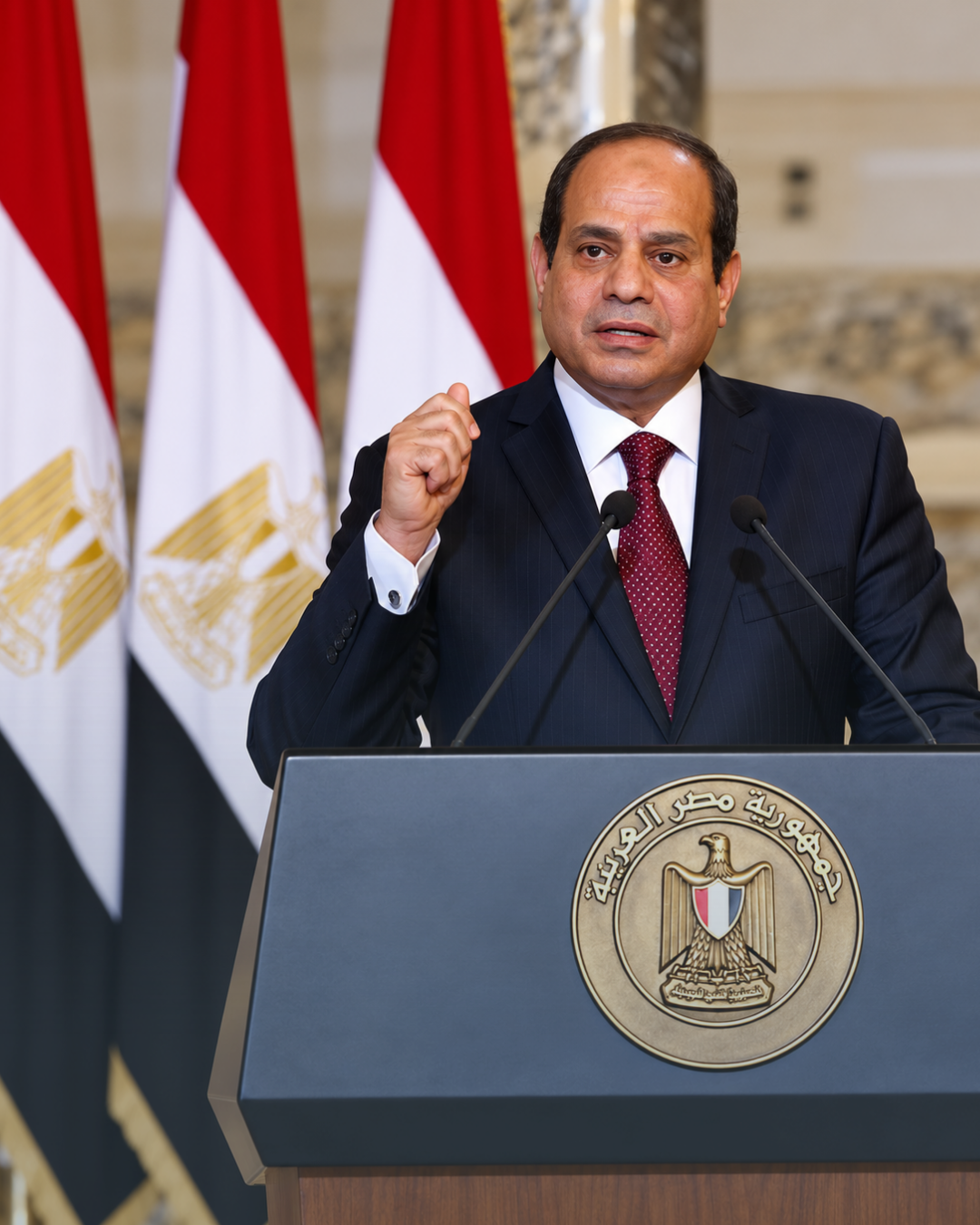
Egyptian President Abdel Fattah El-Sisi has confirmed that his current presidential term will end in 2030, reaffirming his commitment to maintaining Egypt’s existing Constitution and ruling out amendments intended to extend his time in office.
The announcement came on October 17, 2026, during a graduation ceremony at the Egyptian Military Academy in the New Administrative Capital, where the president also outlined plans to prepare a new generation of Egyptian leaders.
The El-Sisi presidency is currently in its third term, which began in April 2024 following his victory in the December 2023 presidential election.
Alongside confirming the 2030 deadline, El-Sisi proposed establishing a 30-month training program at the Egyptian Military Academy to prepare qualified individuals for future leadership positions, including the presidency, ministerial roles, and other senior government responsibilities.
El-Sisi Confirms His Presidency Will End In 2030
President Abdel Fattah El-Sisi made the announcement while addressing graduates and attendees at the Egyptian Military Academy on October 17.
During his speech, the president emphasized that 2030 would mark the conclusion of his current presidential term and that he did not intend to pursue constitutional amendments allowing him to remain in office beyond that date.
He described the matter as settled and not open to further discussion.
The statement followed public speculation about the possibility of additional constitutional changes that could allow him to seek another presidential term.
El-Sisi maintained that preserving the existing constitutional framework was the appropriate course.
However, the president also emphasized the importance of preparing qualified individuals to assume leadership responsibilities before his departure.
He said Egypt needed capable people who understood the country’s institutions, resources, and responsibilities.
His remarks introduced a broader discussion about how future Egyptian leaders could be trained and prepared for public office.
The proposed initiative would involve the Egyptian Military Academy, which already provides education and training for military personnel and selected civilian government employees.
Egypt’s Constitution Limits Presidential Terms
The announcement is closely connected to Egypt’s constitutional rules governing presidential elections and terms in office.
Under Article 140 of Egypt’s Constitution, as amended in 2019, the president serves a six-year term and may not hold office for more than two consecutive terms.
The current constitutional framework was established following amendments approved through a national referendum in April 2019.
Before those changes, the Egyptian Constitution provided for four-year presidential terms.
The 2019 amendments extended presidential terms from four to six years and introduced transitional provisions affecting El-Sisi’s presidency.
Those transitional arrangements extended his second presidential term until 2024 and allowed him to seek an additional six-year term.
Consequently, the amendments enabled El-Sisi to remain in office until 2030 if re-elected.
His October 2026 statement reaffirmed that he does not intend to pursue further constitutional changes to extend his presidency.
The distinction is important because the announced 2030 departure reflects both the end of his current constitutional term and his stated commitment not to seek an extension through additional amendments.
How The 2019 Constitutional Amendments Shaped The 2030 Deadline
The constitutional amendments approved in 2019 played a central role in determining the duration of El-Sisi’s presidency.
The changes were introduced five years after Egypt adopted its 2014 Constitution.
Among the most significant amendments was the extension of presidential terms from four to six years.
The amendments also introduced a transitional provision allowing the sitting president to complete an extended term and subsequently seek one additional six-year term.
According to the official referendum results, 88.83% of participating voters approved the constitutional amendments, with turnout reported at approximately 44%.
Supporters argued that the longer presidential terms could provide greater continuity for government policies and major national development projects.
Critics, meanwhile, raised concerns about the implications of extending presidential tenure and concentrating political authority.
The amendments ultimately established the framework under which El-Sisi contested the December 2023 presidential election.
His victory secured the third term that is scheduled to conclude in 2030.
The president’s October 2026 announcement indicates that he intends to follow that timetable rather than pursue another constitutional extension.
El-Sisi’s Third Presidential Term Began In April 2024
Abdel Fattah El-Sisi first became president of Egypt in 2014, following the political developments of 2013.
He subsequently won a second presidential term in 2018.
The constitutional amendments introduced the following year extended the duration of that term and enabled him to contest another election.
In December 2023, El-Sisi secured victory in Egypt’s presidential election, receiving approximately 89.6% of the valid votes, according to the National Election Authority.
Official figures also placed voter turnout at approximately 66.8%.
The election took place between December 10 and 12, with the final results announced on December 18.
El-Sisi formally took the constitutional oath for his third term on April 2, 2024, during a ceremony at the new headquarters of the House of Representatives in the New Administrative Capital.
His six-year presidential term officially began on April 3, 2024.
Under the current constitutional timetable, it is scheduled to conclude in April 2030.
If completed as scheduled, El-Sisi will have served approximately 16 years as Egypt’s president.
The latest announcement therefore places renewed attention on how the country’s next presidential transition will be organized.
Egyptian Military Academy To Prepare Future Leaders
Alongside confirming the end of his presidency, El-Sisi introduced a proposal to establish a comprehensive leadership preparation program at the Egyptian Military Academy.
The proposed initiative would last approximately 30 months and include more than 7,500 hours of training.
According to the president, the program would help participants develop a deeper understanding of Egypt’s institutions, national resources, administrative responsibilities, and strategic priorities.
The initiative is intended to prepare individuals for positions across different branches of government.
These include the presidency, ministries, governorates, parliament, and other senior state institutions.
El-Sisi emphasized that leadership responsibilities require extensive preparation and practical knowledge of government operations.
He also suggested that the program could accommodate several hundred participants, potentially reaching as many as 1,000 individuals.
The Armed Forces would finance the training, according to the proposal.
However, the initiative remains subject to further planning, selection procedures, and potential legislation.
At the time of the announcement, detailed implementation arrangements had not been finalized.
Who Would Qualify For Egypt’s Proposed Leadership Program?
The proposed training initiative would focus on highly educated individuals with professional and academic qualifications.
During his October 17 speech, El-Sisi suggested that applicants should hold doctoral degrees from recognized Egyptian or international universities.
He also proposed an age range of 40 to 50 years for participants entering the program.
Applicants would undergo assessments and selection procedures intended to evaluate their qualifications and suitability for leadership training.
According to the president, the initiative could accommodate between 200 and 1,000 participants, depending on its final structure.
The program would provide instruction in the functioning of the Egyptian state, its institutions, resources, and national responsibilities.
El-Sisi also suggested that individuals with at least six years of government experience could be exempted from the training requirement.
The president emphasized that selection should be based on qualifications and demonstrated ability rather than personal connections.
He rejected suggestions that the initiative was intended to prepare a particular relative or family member to succeed him.
However, these proposals have not yet been established as binding requirements for presidential candidates.
Under Egypt’s existing Constitution, the legal conditions for presidential candidacy are governed by specific constitutional provisions and election laws.
Any attempt to introduce additional eligibility requirements would therefore require further legal examination.
A Committee Would Develop The Leadership Training Framework
To move the proposal forward, El-Sisi called for the establishment of a committee responsible for developing the program’s legal and administrative framework.
The committee would be led by the Speaker of the House of Representatives and include senior officials, legal specialists, intellectuals, and political figures.
The ministers of higher education and justice would also participate in the process.
Its responsibilities would include developing selection criteria and preparing potential legislation governing the initiative.
The president emphasized the importance of establishing transparent procedures and ensuring that candidates were evaluated according to consistent standards.
The proposed program would seek to combine academic qualifications with practical knowledge of government administration.
However, several questions remain unresolved.
These include how participants would be selected, whether the program would become a formal requirement for particular positions, and how it would interact with existing constitutional provisions.
The committee’s recommendations and any subsequent legislative developments would be necessary to establish the program’s final structure.
Until those steps are completed, the initiative remains a presidential proposal rather than an established electoral framework.
Egypt’s Proposed Leadership Program Raises Constitutional Questions
The announcement has also prompted discussion about the relationship between leadership training and constitutional eligibility for public office.
Under Article 141 of Egypt’s Constitution, presidential candidates must satisfy several requirements.
These include Egyptian nationality and parentage, possession of civil and political rights, completion of or exemption from military service, and a minimum age of 40.
The Constitution does not currently require presidential candidates to hold doctoral degrees or complete a training program at the Egyptian Military Academy.
Meanwhile, Article 142 establishes requirements concerning parliamentary recommendations or public endorsements.
The proposed training initiative therefore introduces questions about whether participation would be voluntary or become a condition for certain leadership positions.
Supporters of the initiative argue that structured preparation could improve administrative competence and provide potential leaders with knowledge of the state’s institutions.
Critics and political observers have questioned whether additional requirements could restrict the range of individuals eligible to compete for public office.
Others have raised concerns about the role of a military institution in preparing candidates for civilian political leadership.
These discussions highlight the importance of distinguishing between professional development programs and the constitutional process governing elections.
Any future legislation would need to be examined in relation to Egypt’s existing legal framework.
The authorities have not yet published final rules explaining how the proposal would operate.
Why The Egyptian Military Academy Was Chosen
The Egyptian Military Academy has increasingly expanded its educational role beyond traditional military training.
In addition to preparing military officers, the academy has provided training to selected employees and recruits working within civilian state institutions.
These programs have included participants from different government sectors and judicial bodies.
The academy’s educational activities focus on discipline, national security, administrative knowledge, and institutional responsibilities.
El-Sisi’s proposal would extend that model to individuals preparing for senior government positions.
During his speech, the president emphasized the importance of developing leaders who understand the country’s institutions and national responsibilities before assuming office.
He also referred to the Armed Forces’ constitutional responsibilities concerning national security and the protection of state institutions.
The proposed expansion has nevertheless attracted attention because of the military’s longstanding influence on Egyptian political and administrative life.
Egypt’s armed forces have historically played a central role in the country’s political system.
The possibility of using a military institution to train future civilian leaders therefore raises broader questions about the relationship between military education, political leadership, and electoral participation.
The final structure of the initiative will determine how those responsibilities are defined.
What Happens When El-Sisi’s Presidential Term Ends In 2030?
Under Egypt’s existing constitutional framework, a presidential election must take place before the conclusion of the current term.
Article 140 establishes that presidential election procedures should begin at least 120 days before the end of the sitting president’s term.
The election results must also be announced at least 30 days before that term concludes.
These requirements are intended to establish a timetable for the electoral process and the transfer of presidential authority.
El-Sisi’s current term began in April 2024 and is scheduled to end in April 2030.
Consequently, the next presidential election would be organized ahead of that deadline under the applicable constitutional and electoral procedures.
However, the official schedule for the next election has not yet been announced.
The identity of future presidential candidates also remains unknown.
Although El-Sisi has outlined a proposal for preparing potential leaders, the announcement does not establish a specific successor or confirm which individuals will participate in the next election.
Egypt’s National Election Authority remains responsible for administering presidential elections under the country’s legal framework.
The eventual electoral arrangements will depend on the applicable laws and official decisions made closer to the end of the current term.
Why El-Sisi’s 2030 Announcement Matters
The president’s statement comes at a time when Egypt faces several major political, economic, and regional challenges.
Domestic economic priorities include managing public finances, supporting investment, expanding employment opportunities, and addressing pressures on household incomes.
At the regional level, Egypt remains involved in diplomatic discussions concerning developments in Gaza, Sudan, Libya, and the wider Middle East.
Against this background, the announcement introduces a clearer publicly stated timetable for the conclusion of the current presidency.
It also places the question of future leadership preparation into the national discussion more than three years before the scheduled end of El-Sisi’s term.
The proposed training initiative reflects the president’s stated preference for preparing experienced individuals before they assume senior government responsibilities.
At the same time, the proposal has encouraged debate about how future leaders should be selected and how existing constitutional protections should be maintained.
For political observers, the coming years will provide an opportunity to assess whether the proposed program develops into a formal institution and how it relates to the presidential electoral process.
The distinction between the president’s stated intentions and the final legal arrangements remains important.
Egypt Looks Ahead To Its Next Presidential Transition
With El-Sisi confirming that his presidential term will end in 2030, attention is increasingly turning toward the country’s future leadership and the constitutional procedures governing the next presidential election.
The announcement reaffirms the current presidential timetable established following the 2019 constitutional amendments and El-Sisi’s re-election in December 2023.
It also introduces a new proposal for preparing future political and administrative leaders through the Egyptian Military Academy.
Although the initiative has yet to be finalized, it has already prompted discussion about leadership qualifications, political participation, and constitutional requirements.
The president has made clear that he does not intend to pursue amendments extending his current tenure.
However, the practical arrangements for the next electoral process and the proposed training program will require further clarification.
As Egypt approaches 2030, developments surrounding the Constitution, presidential elections, and the preparation of future leaders will remain important elements of the country’s political landscape.