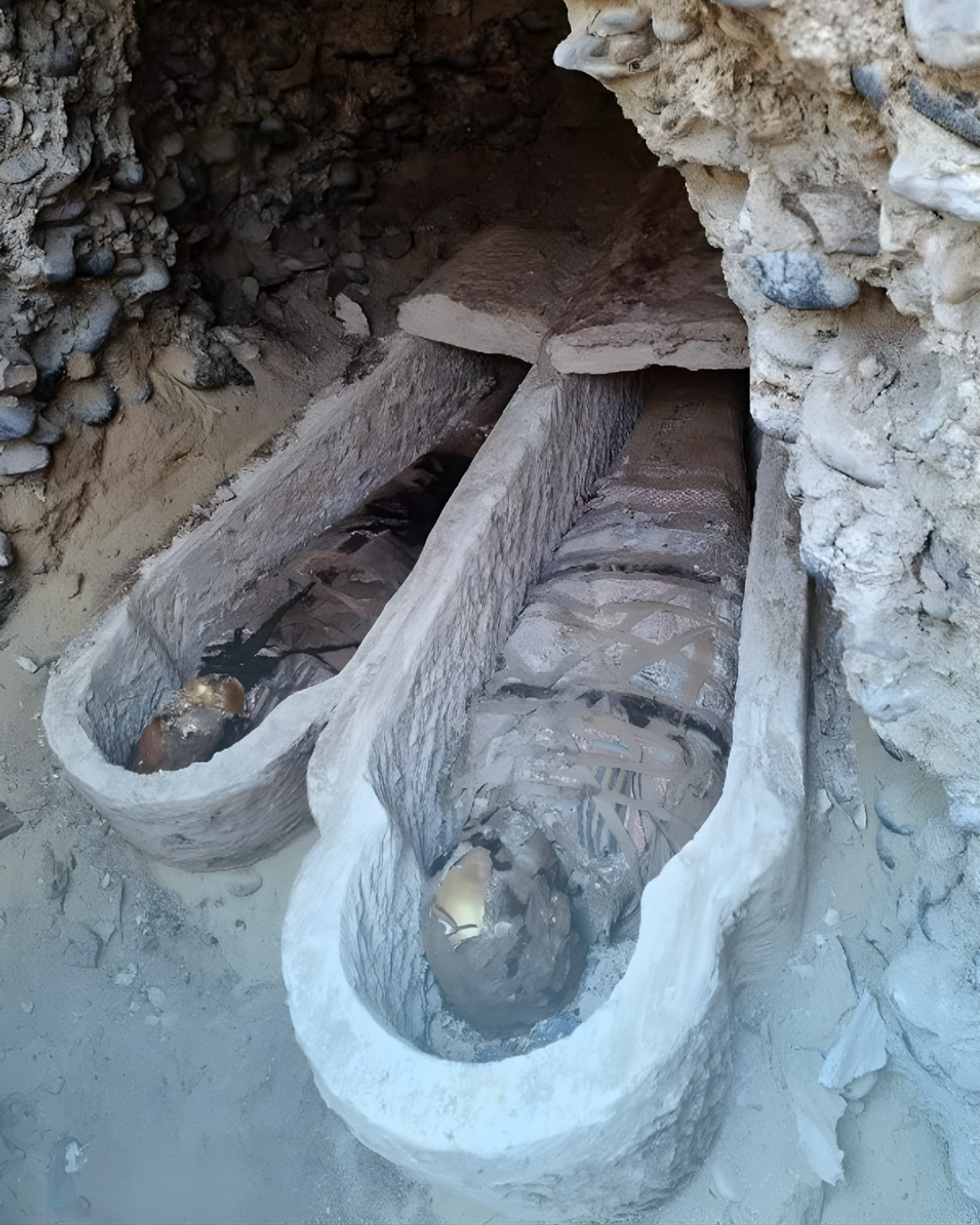
A significant archaeological discovery has been made in El-Bahnasa, Minya, where a Roman-era tomb containing mummies and ritual objects has been uncovered, offering new insights into burial practices during the Greek and Roman periods in Egypt.
The excavation was carried out by a Spanish archaeological team from the University of Barcelona and the Institute of the Ancient Near East, under the leadership of Maite Mascort and Esther Pons Mellado. The discovery was announced by Egypt’s Ministry of Tourism and Antiquities.
Among the most notable findings are several mummies placed inside wooden coffins, some wrapped in intricately decorated linen featuring geometric patterns. Archaeologists also uncovered unique burial items, including three golden tongues and one made of copper. These objects were placed inside the mouths of the deceased, believed to be part of funerary rituals linked to the afterlife.
In addition, traces of gold leaf were found on some of the mummies, suggesting the use of decorative elements to honor the dead.
One of the most remarkable discoveries was a papyrus found within one of the mummies, containing text from The Iliad by Homer, specifically from Book Two. Experts believe this rare find highlights cultural and literary influences during that historical period.
Further excavations revealed a trench east of Ptolemaic Tomb No. 67, containing three limestone burial chambers in varying states of preservation. One chamber held cremated remains of an adult, alongside the bones of an infant and the head of a feline, all carefully wrapped in textiles. Another chamber contained the remains of two individuals along with animal bones, suggesting complex burial practices.
Additional artefacts discovered south of the site include terracotta and bronze figurines, featuring depictions of Harpocrates and a small statue of Cupid, reflecting a blend of Egyptian and Greco-Roman influences.
In Tomb No. 65, researchers documented more Roman-period mummies, painted wooden coffins, and additional golden and copper tongues within an underground burial structure. Evidence of ancient looting was also identified at the site.
Officials, including Minister of Tourism and Antiquities Sherif Fathy, emphasized that the discovery adds to Minya’s growing reputation as a rich archaeological region. Meanwhile, the Supreme Council of Antiquities highlighted the importance of these findings in expanding understanding of ancient burial traditions and cultural interactions.
This discovery not only sheds light on ancient funerary customs but also reinforces Egypt’s ongoing role as one of the world’s most significant archaeological landscapes.