
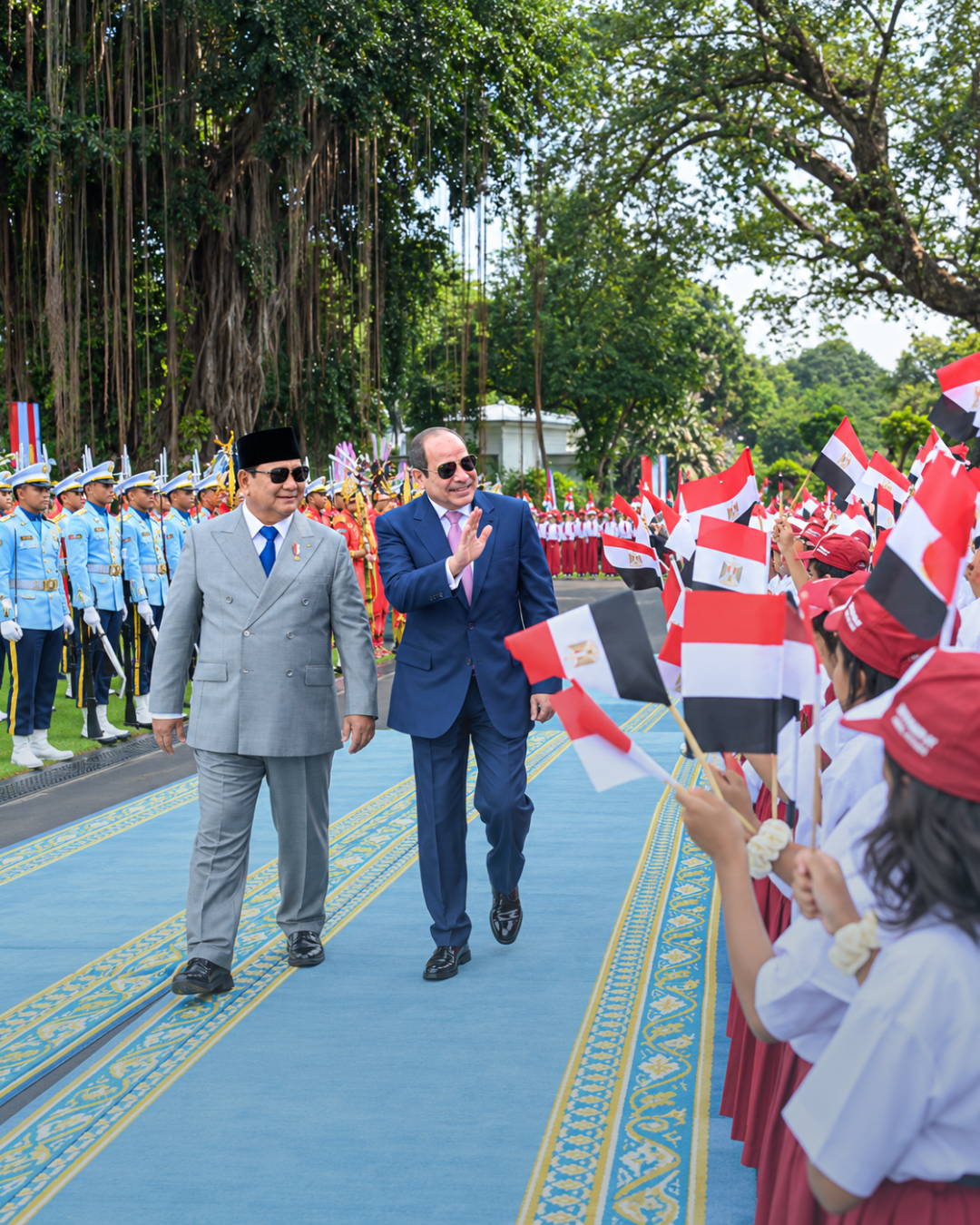
Egypt and Indonesia signed four cooperation agreements on October 11, 2026, marking another step in strengthening their strategic partnership and expanding collaboration across several important sectors.
The agreements were signed during Egyptian President Abdel Fattah El-Sisi’s official visit to Jakarta, where he met with Indonesian President Prabowo Subianto at the Merdeka Presidential Palace.
Covering strategic cooperation, visa exemptions, statistics, and maritime affairs and fisheries, the agreements represent a new stage in diplomatic and economic relations between the two countries.
The meeting also highlighted a broader ambition to increase bilateral trade to $5 billion by 2030, alongside expanding investment opportunities, industrial cooperation, and coordination on regional and international issues.
Egypt And Indonesia Sign Four Agreements During Presidential Meeting
The signing ceremony took place at the Merdeka Presidential Palace in Jakarta on October 11, following bilateral discussions between President Abdel Fattah El-Sisi and President Prabowo Subianto.
The Egyptian president visited Indonesia on October 10 and 11 as part of an official diplomatic visit aimed at advancing the strategic partnership established between the two countries in 2025.
During the visit, the leaders held private talks followed by expanded discussions involving senior officials and government delegations.
Following the meetings, they witnessed the signing of four memoranda of understanding, each targeting a different area of bilateral cooperation.
The agreements cover:
1. Strategic Partnership Action Plan
A framework designed to guide the implementation of the strategic partnership between Egypt and Indonesia.
2. Visa Exemptions
An agreement covering visa exemptions for holders of diplomatic, official, service, and special passports.
3. Statistical Cooperation
A memorandum of understanding aimed at strengthening cooperation between the countries in the field of statistics.
4. Maritime Affairs And Fisheries
An agreement supporting bilateral cooperation in maritime affairs and the fisheries sector.
The four agreements are intended to translate the countries’ broader diplomatic partnership into practical areas of cooperation.
[Image: President Abdel Fattah El-Sisi and President Prabowo Subianto during the signing ceremony in Jakarta.]
A New Step In The Egypt-Indonesia Strategic Partnership
The latest agreements build on an important diplomatic development that took place in April 2025.
During President Prabowo Subianto’s visit to Cairo on April 12, 2025, the two leaders signed a declaration officially elevating relations between Egypt and Indonesia to a strategic partnership.
The declaration established a broader framework for cooperation in political, economic, security, defense, educational, and cultural affairs.
It also emphasized the importance of expanding collaboration in manufacturing, trade, investment, information technology, food security, and energy.
The October 2026 meeting in Jakarta represents a continuation of that commitment.
Rather than announcing an entirely new diplomatic relationship, the latest agreements are designed to strengthen the existing partnership and establish additional mechanisms for cooperation.
One of the most important outcomes is the Strategic Partnership Action Plan, which provides a framework for translating diplomatic commitments into coordinated activities.
Both governments have emphasized the importance of maintaining regular political consultations and strengthening existing bilateral institutions.
The agreements also follow several high-level exchanges between the two countries, reflecting continued engagement between their governments.
Egypt And Indonesia Aim To Reach $5 Billion In Trade By 2030
Economic cooperation was among the central subjects discussed during the presidential meeting.
Egypt and Indonesia announced an ambition to increase bilateral trade to $5 billion by 2030, with both governments emphasizing the importance of improving market access and expanding business opportunities.
According to Egypt’s Central Agency for Public Mobilization and Statistics (CAPMAS), trade between the two countries reached approximately $1.6 billion during the first eight months of 2026.
This represented an increase from approximately $1.4 billion during the corresponding period in 2025.
The figures reflect growing commercial relations, although the balance of trade remains heavily weighted toward Indonesian exports.
During the first eight months of 2026, Egyptian exports to Indonesia reached approximately $66 million, while imports from Indonesia amounted to around $1.5 billion.
Egypt’s main exports included mineral products, cement-related materials, agricultural goods, and industrial products.
Meanwhile, Indonesia supplied Egypt with significant quantities of vegetable oils, coffee, tea, spices, electrical equipment, and other manufactured goods.
The two governments have identified trade expansion as a priority, with plans to remove commercial obstacles and encourage additional investment.
They also discussed the possibility of developing a broader economic partnership agreement to facilitate trade and strengthen private-sector cooperation.
[Image: Egyptian and Indonesian delegations holding bilateral economic discussions in Jakarta.]
Investment Opportunities In Agriculture, Energy And Manufacturing
Beyond the four signed agreements, Egypt and Indonesia discussed opportunities for deeper cooperation in several economic sectors.
Particular attention was given to collaboration between Indonesia’s Danantara investment institution and Egypt’s Future of Egypt for Sustainable Development agency.
The two organizations have been exploring opportunities involving agricultural products, industrial raw materials, and investment projects.
Among the sectors identified for cooperation are the production and distribution of crude palm oil and its derivatives, alongside phosphate fertilizers and related materials.
The two countries also expressed interest in expanding joint investment opportunities into infrastructure, energy, logistics, and agribusiness.
For Egypt, these discussions align with efforts to strengthen its manufacturing base and expand its role as a regional production and export destination.
For Indonesia, the cooperation could provide additional opportunities to reach markets in the Middle East and Africa.
Both governments emphasized the importance of encouraging business partnerships and expanding private-sector participation in the development of bilateral relations.
Although the discussions identified several promising areas, individual projects will depend on further agreements and implementation by the relevant institutions.
Visa Exemptions And Cooperation In Maritime Affairs
Two of the four agreements focus on specific areas of administrative and sectoral cooperation.
The visa exemption memorandum is intended to facilitate official travel between Egypt and Indonesia.
The agreement applies to holders of diplomatic, official, service, and special passports.
It does not establish visa-free travel for all Egyptian or Indonesian tourists, and ordinary passport holders should continue checking the applicable entry requirements before traveling.
The measure is expected to support official exchanges by making travel arrangements easier for eligible government representatives and diplomatic personnel.
Meanwhile, the memorandum covering maritime affairs and fisheries introduces another area of bilateral collaboration.
Both Egypt and Indonesia have significant interests in maritime activities, fisheries, and the management of marine resources.
The agreement creates a framework for cooperation in these sectors, potentially supporting technical exchanges and future joint initiatives.
Indonesia’s extensive maritime geography and Egypt’s position along the Mediterranean Sea, Red Sea, and Suez Canal give the countries different experiences in maritime development.
The agreement provides a basis for exploring how those capabilities could support mutually beneficial cooperation.
Egypt And Indonesia Strengthen Statistical Cooperation
The third sector-specific memorandum focuses on cooperation in statistics.
Reliable statistical information plays an important role in economic planning, public administration, and the evaluation of national development strategies.
Through the agreement, Egypt and Indonesia have established a framework for greater collaboration in this field.
Such cooperation can support exchanges of technical knowledge, statistical practices, and institutional experience.
It may also help strengthen the quality of information used to evaluate economic and social developments.
For governments seeking to expand bilateral trade and investment, reliable data can provide an important foundation for policy decisions.
The statistical cooperation agreement therefore complements the wider economic priorities discussed during the presidential meeting.
However, the governments have not publicly detailed all implementation arrangements or individual projects that may result from the memorandum.
Presidents El-Sisi And Prabowo Discuss Regional Security And Palestine
The presidential meeting extended beyond economic cooperation to include discussions about regional security and major international developments.
Both leaders reaffirmed their support for a political settlement of the Palestinian question based on the establishment of an independent Palestinian state along the June 4, 1967 borders, with East Jerusalem as its capital.
They also expressed opposition to the forced displacement of Palestinians and emphasized the importance of humanitarian assistance and efforts to achieve lasting peace.
Indonesia acknowledged Egypt’s role in facilitating humanitarian aid to Gaza and expressed its intention to continue supporting humanitarian efforts.
The leaders also discussed tensions affecting the wider Middle East, including developments in the Gulf region.
In their joint statement, they called for de-escalation, respect for national sovereignty, and the resolution of conflicts through dialogue and diplomacy.
Another important subject was Egypt’s Nile water security.
President Prabowo expressed support for Egypt’s efforts to protect its water rights, while both countries emphasized the importance of international legal principles governing shared water resources.
The discussions highlighted the political dimension of the Egypt-Indonesia partnership, extending cooperation beyond bilateral economic interests.
Education And Cultural Relations Remain Important
Education and cultural cooperation also formed part of the discussions between Egypt and Indonesia.
The two countries share longstanding educational connections, particularly through Al-Azhar University in Cairo, which has welcomed generations of Indonesian students.
The university remains an important destination for Indonesians pursuing studies in Arabic language, Islamic studies, and related academic disciplines.
During the Jakarta meeting, President Prabowo welcomed Al-Azhar University’s November 2025 decision to introduce Indonesian language studies within its Faculty of Languages and Translation.
The two presidents also expressed interest in expanding student exchanges, academic partnerships, cultural cooperation, and youth engagement.
These initiatives are intended to strengthen connections between Egyptian and Indonesian communities while supporting the exchange of knowledge and professional experience.
The countries also discussed opportunities for technical cooperation and capacity-building programs.
Beyond diplomatic and commercial agreements, educational relationships continue to provide an important foundation for long-term ties between the two nations.
A Diplomatic Relationship Built Over Decades
Egypt and Indonesia have maintained diplomatic relations for decades, with cooperation extending across political, economic, educational, and cultural fields.
Egypt was among the early countries to recognize Indonesia’s independence, establishing a historical connection that remains an important part of their diplomatic relationship.
Both countries have also participated in international initiatives supporting cooperation among developing nations.
Their shared involvement in organizations such as the United Nations and the Organization of Islamic Cooperation has provided additional opportunities for diplomatic engagement.
Over time, the relationship has expanded beyond political dialogue to include commercial exchanges, educational cooperation, and institutional partnerships.
The declaration signed in April 2025 represented an important development by formally elevating relations to the strategic partnership level.
The agreements signed in October 2026 are intended to build on that foundation, introducing additional mechanisms to support cooperation.
The frequent presidential exchanges also reflect the importance both governments place on maintaining direct communication and developing their relationship.
What Comes Next For Egypt And Indonesia?
Following the signing of the four agreements, attention will turn toward how the two governments implement their commitments.
The Strategic Partnership Action Plan is expected to provide a framework for coordinating future cooperation, while the sector-specific memoranda establish opportunities for collaboration in visas, statistics, and maritime affairs.
Economic relations will remain a major priority.
Both countries have expressed interest in increasing trade, attracting investment, and exploring joint industrial and agricultural projects.
However, reaching the $5 billion trade target by 2030 will require continued progress in market access, business engagement, and commercial cooperation.
Further institutional discussions will also be important in determining how the agreements translate into operational initiatives.
At the diplomatic level, Egypt and Indonesia have committed to maintaining closer political coordination and consultation on regional and international developments.
The next stages of cooperation will determine how effectively the October agreements support those objectives.
A New Chapter In Egypt-Indonesia Relations
The signing of four cooperation agreements between Egypt and Indonesia represents another development in the countries’ expanding strategic partnership.
From maritime affairs and statistics to diplomatic travel and economic coordination, the agreements establish additional opportunities for collaboration across different sectors.
The meeting also highlighted wider ambitions, including the proposed expansion of trade to $5 billion by 2030, additional investment partnerships, and stronger coordination on regional issues.
Building on the strategic partnership established in April 2025, the October 2026 agreements reflect the continuing efforts of both governments to deepen bilateral relations.
As Egypt and Indonesia move toward implementing these commitments, their cooperation will be shaped by the progress of the newly signed agreements and the economic and diplomatic initiatives discussed in Jakarta.