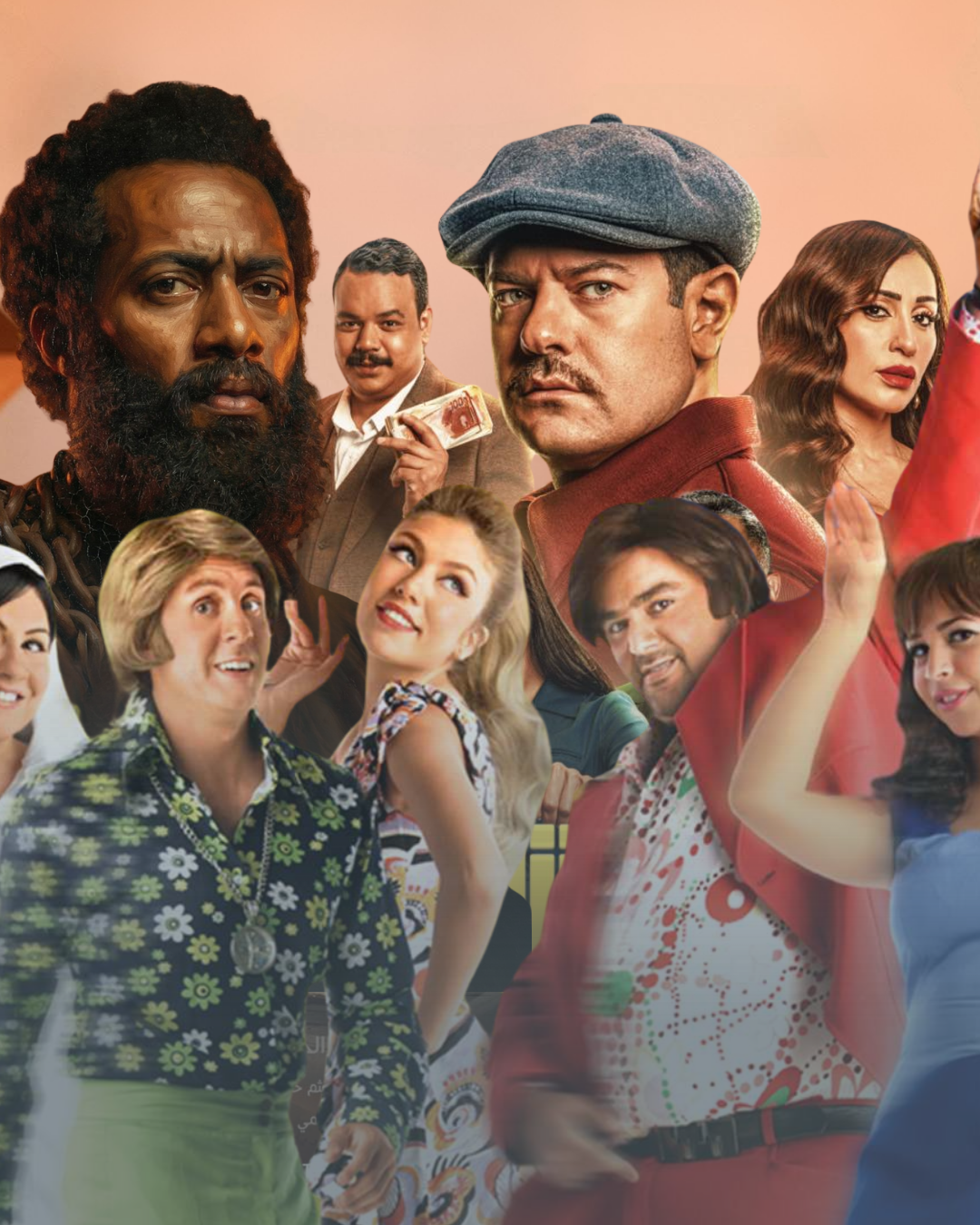
Sometimes all it takes is the right costume, an old Cairo street, a vintage car or a completely different world to make us forget what year we’re actually living in.
Egyptian cinema has always had a special relationship with the past. Some movies recreate history on an epic scale, while others use a previous era as the setting for comedy, romance, adventure or political drama. And then there are films that literally throw their characters into a time machine.
From the 19th-century world of Asad to the gloriously colorful 1970s of Samir w Shahir w Bahir, these Egyptian movies didn’t just tell stories set in the past — they made us feel like we had travelled there with them.
1. Asad — 19th-Century Egypt
Few recent Egyptian films have committed to creating another historical world on the scale of Asad.
Directed by Mohamed Diab and starring Mohamed Ramadan, the 2026 historical epic takes place in 19th-century Egypt and follows Asad, an enslaved man whose refusal to accept oppression ultimately develops into a wider rebellion. The cast also includes Maged El Kedwany, Razane Jammal, Aly Kassem, Ahmed Dash and Kamel El Basha.
But before the story even takes over, Asad makes its time period impossible to ignore.
The markets, palaces, slave quarters, rural landscapes, weapons and clothing all work together to build a world that feels far removed from modern Egypt. Production design was handled by Ahmed Fayez, with Reem El Adl responsible for costume design.
The scale behind that recreation was considerable. The production reportedly spent more than a year on location scouting and visual world-building, followed by months of pre-production dedicated to recreating 19th-century Egypt.
And it shows.
There are moments where Asad feels less like watching contemporary actors dressed in period costumes and more like looking through a window into another century.
The film’s cinematography reinforces that atmosphere with dusty landscapes, crowded marketplaces, dramatic interiors and large-scale battle scenes. Contemporary reviews particularly highlighted its production design and costumes as some of the strongest elements of the film.
If we’re talking about Egyptian movies that visually transported us into history, Asad earns its place immediately.

2. Darwish — Egypt in the 1940s
If Asad takes us into a distant historical world, Darwish transports us somewhere much closer to the Egypt we recognize — but still unmistakably from another time.
Released in 2025, the film is set in the 1940s and stars Amr Youssef as Darwish, a charming con artist whose schemes unexpectedly turn him into a popular hero.
Directed by Walid El Halfawy and written by Wissam Sabry, the film also stars Dina El Sherbiny, Tara Emad, Mohamed Shahin and Mostafa Gharib.
But honestly, part of the fun is simply looking at it.
The suits. The dresses. The hairstyles. The cars. The old signs. The cafés. The streets.
Darwish embraces the visual identity of 1940s Egypt so strongly that the period almost becomes another character in the movie.
The filmmakers used both real historical locations and detailed recreations to build the setting, with some Downtown Cairo environments created using extensive 3D work. Costume designer Dina Nadim also developed outfits down to details including suits and shoes specifically to place the characters convincingly within the period.
Tara Emad, who plays Kariman, even revealed that she watched films from the 1940s while preparing for her character, using cinema from that period to better understand the era she was recreating.
That attention gives Darwish its distinctive charm.
It isn’t simply a modern action-comedy with old-fashioned clothing thrown on top. The production deliberately tries to surround the characters with the visual language of the 1940s.
And for two hours, modern Cairo suddenly feels very far away.

3. Samir w Shahir w Bahir — Straight to the 1970s
While every other movie here recreates the past, Samir w Shahir w Bahir deserves extra points because its characters actually travel there.
The 2010 comedy stars Ahmed Fahmy, Hesham Maged and Chico as three half-brothers — Samir, Shahir and Bahir — who accidentally activate a time machine and find themselves thrown into the past.
And not just any point in the past.
They land in the 1970s, around the time their father is supposed to meet their three mothers.
Which becomes a problem when the brothers realize that interfering with those relationships could prevent one — or all — of them from ever being born.
The movie completely commits to the joke.
Suddenly we’re surrounded by bell-bottom trousers, long hairstyles, bright colors, Fiat 128s and unmistakably ’70s décor, while three men from 2010 try to figure out how they’re going to survive long enough to repair the future.
The film also has fun with Egyptian pop culture from the period, placing its characters around the cinema, music, fashion and social world their parents would have experienced.
That makes the nostalgia part of the comedy itself.
Samir, Shahir and Bahir aren’t simply characters living in the 1970s. They’re outsiders reacting to it just like the audience would if someone suddenly dropped us there.
And that’s exactly why it remains such a fun time-travel movie.
Where Asad wants us to believe we are genuinely in another century, Samir w Shahir w Bahir keeps reminding us how strange travelling into another generation would actually be.
Also, very few movies can make 60-piaster meat prices part of a time-travel joke.

4. El Kenz 1 & 2 — Why Visit One Era When You Can Visit Several?
And then there’s El Kenz, which looked at the idea of choosing one historical period and basically said: Why?
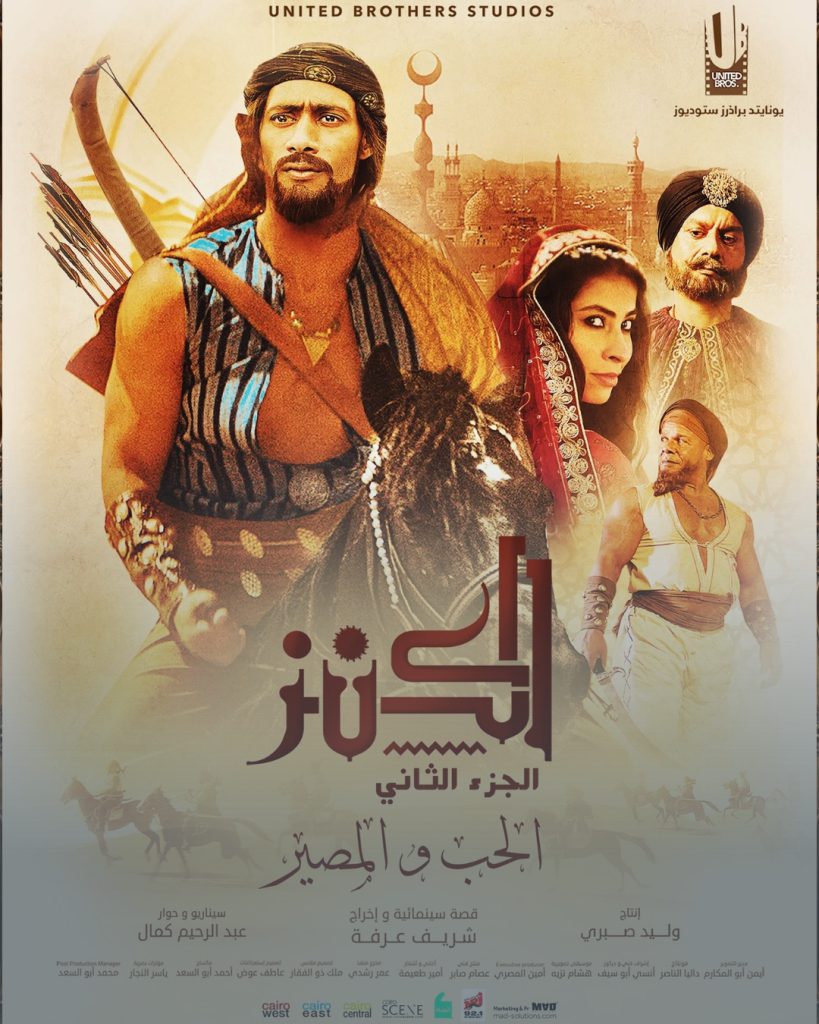
Directed by Sherif Arafa and written by Abdel Rahim Kamal, the two-part saga moves between several periods of Egyptian history, using interconnected stories to explore themes of power, corruption, love and ambition across generations.
The first film, released in 2017, begins in 1975 with Hassan Bishr, played by Mohamed Saad, returning to Luxor after receiving a message from his uncle.
There, he discovers that his father has left behind recordings and ancient documents containing stories from different periods — stories that may lead him toward a hidden treasure.
And that’s where the real journey starts.
Across El Kenz and El Kenz 2: El Hob w El Maseer, audiences are moved between stories involving Queen Hatshepsut’s ancient Egypt, the adventures of Ali Al-Zeibaq, played by Mohamed Ramadan, and the comparatively modern world surrounding Bashir El-Katatni, played by Mohamed Saad.
That means one franchise gives us ancient temples and royal politics, traditional markets and folk heroes, and then suits, mansions and the social atmosphere of 20th-century Egypt.
The cast only makes the journey bigger.
Alongside Mohamed Saad and Mohamed Ramadan, the films feature Hend Sabry, Ahmed Rizk, Amina Khalil, Ruby, Sawsan Badr and an enormous ensemble of Egyptian stars.
Visually, each timeline has to feel distinct enough that audiences immediately understand they’ve entered another chapter of Egypt’s past.
That’s what makes El Kenz particularly ambitious.
Most period movies ask production designers and costume departments to convincingly recreate one historical setting.
El Kenz asks them to keep changing centuries.
And somehow, that’s part of the fun.
Different Movies, Different Time Machines
What makes these four choices interesting is that none of them takes us into the past in quite the same way.
Asad gives us the scale of a historical epic and drops us into 19th-century Egypt.
Darwish turns the 1940s into a stylish playground filled with con artists, vintage fashion and old Cairo.
Samir w Shahir w Bahir literally sends three modern men into the 1970s and lets us experience the culture shock alongside them.
And El Kenz refuses to settle for one period at all, jumping across centuries to tell stories connected by the same themes.
That’s part of what period films can do when they work.
History stops feeling like something sitting inside a textbook and becomes a place filled with people, streets, clothes, music, relationships and everyday details.
We might only stay there for two hours.
But with the right movie, that’s more than enough to make us feel like we travelled back in time.