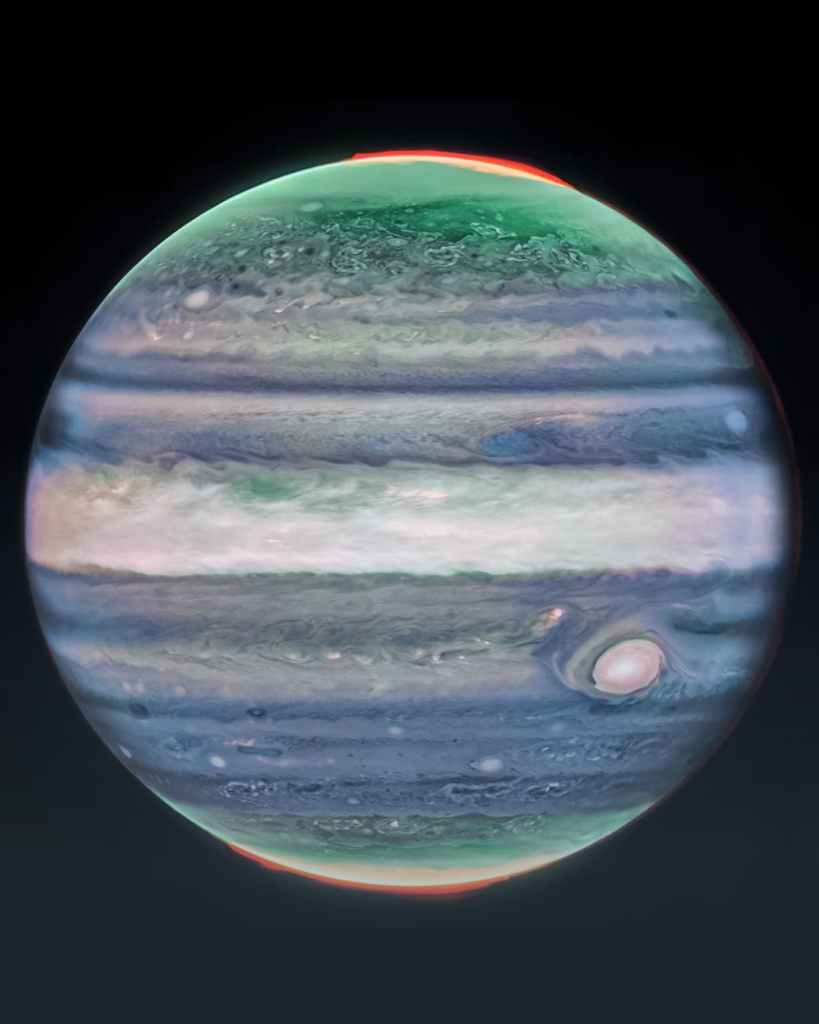
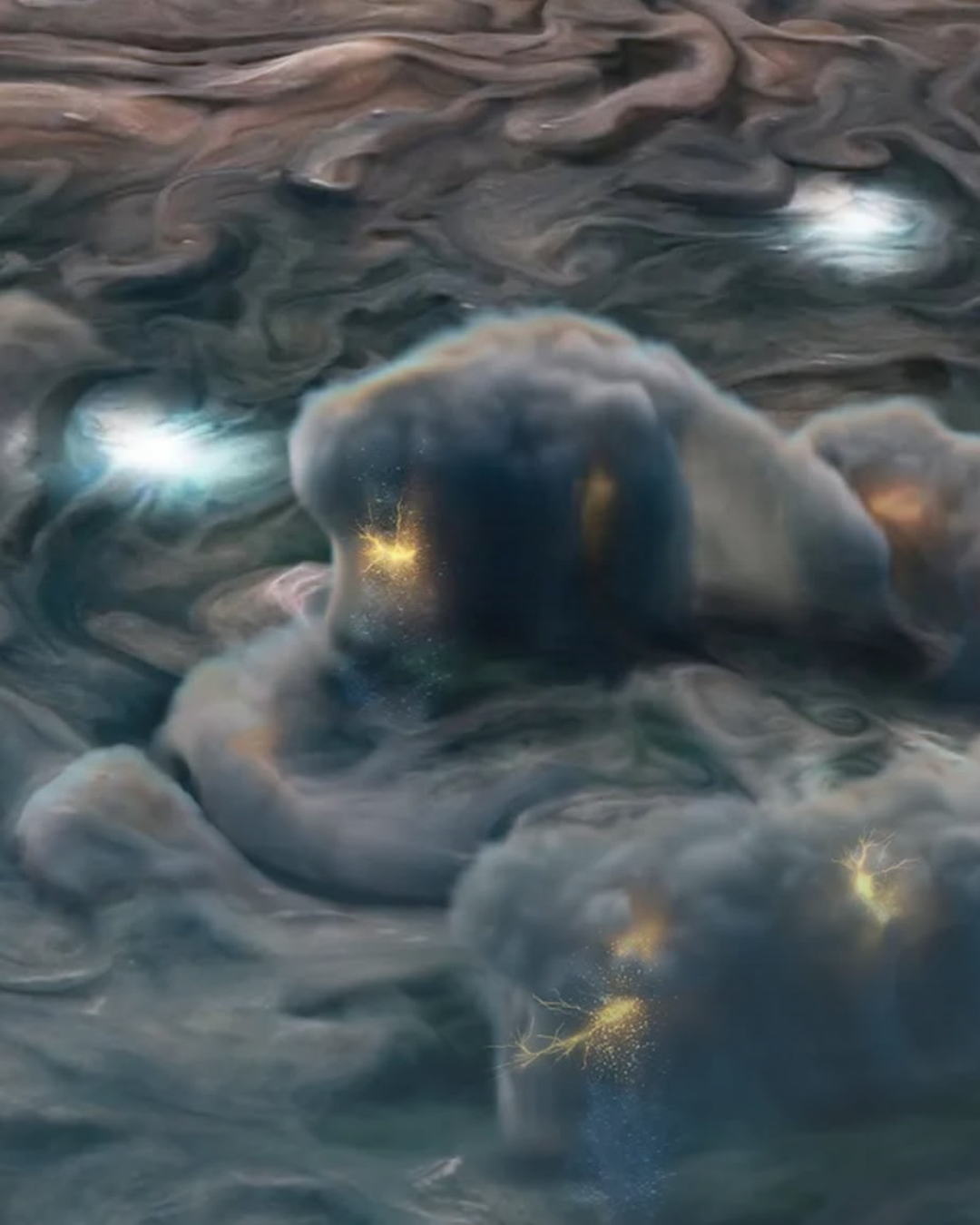
NASA has shared spectacular close-up views of Jupiter, revealing the swirling storms, powerful jet streams and chaotic cloud formations that make the solar system’s largest planet one of its most visually striking worlds.
The images come from NASA’s Juno mission, whose JunoCam instrument has been capturing remarkably detailed views of Jupiter during the spacecraft’s repeated close passes over the gas giant.
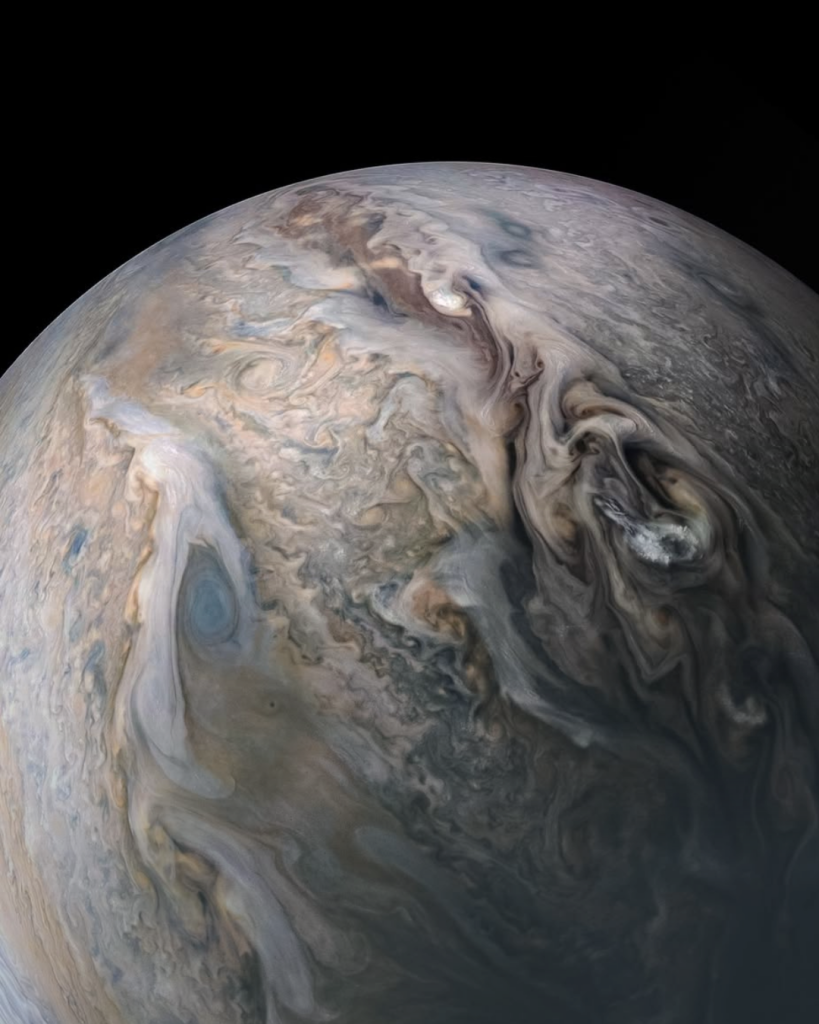
Among the images recently highlighted by NASA is a color-enhanced view of Jupiter’s northern hemisphere, showing a tangled landscape of clouds and cyclonic storms in extraordinary detail. The image was captured during Juno’s 61st close flyby of Jupiter on May 12, 2024, before being processed by citizen scientist Gary Eason and highlighted by NASA in June 2026.
A Closer Look at Jupiter’s Chaotic Clouds
Rather than the relatively orderly bands usually visible when Jupiter is viewed from a distance, the close-up reveals an intensely complicated atmospheric environment.
The photograph focuses on what scientists call a folded filamentary region, an area where Jupiter’s familiar east-west jet streams begin to break down.
According to NASA, these regions contain chaotic clouds and cyclonic storms that can evolve dramatically over just a matter of days.
Jupiter is famous for its alternating light and dark cloud bands, known as zones and belts. These structures are driven by powerful atmospheric winds moving in different directions.
Where those winds interact, enormous vortices, turbulent boundaries and swirling storms can develop, creating the elaborate patterns captured by JunoCam.
Juno Offers an Extraordinary View of Jupiter
NASA’s Juno spacecraft has transformed scientists’ understanding of Jupiter since entering orbit around the planet in July 2016.
Unlike previous missions that largely observed Jupiter from greater distances, Juno repeatedly swoops close to the planet’s cloud tops, allowing its instruments to investigate everything from the atmosphere and magnetic field to Jupiter’s deep internal structure.
Its visible-light camera, JunoCam, has become particularly well known for producing some of the most detailed and dramatic images ever taken of Jupiter.
NASA maintains a large JunoCam gallery featuring close-ups of the planet’s poles, massive storms, jet streams and cloud formations, along with images of several of Jupiter’s moons.
Jupiter’s Winds Create Constant Turbulence
Some of the patterns visible in Juno’s imagery are produced by one of Jupiter’s most defining characteristics: its incredibly powerful winds.
The planet’s atmospheric bands rotate in alternating directions, producing boundaries where different air currents collide.
NASA has explained that these opposing winds generate eddies of many different sizes, which appear as vortices and storms within Jupiter’s atmosphere.
Juno has also revealed that these jet streams are far more than a surface phenomenon. Data gathered by the spacecraft showed that Jupiter’s powerful atmospheric jets extend deep beneath the visible cloud tops, helping scientists understand how the planet’s distinctive striped appearance connects to its interior.
Some Storms Can Be Hundreds of Kilometers Wide
The immense scale of Jupiter can make even apparently small features in photographs deceptively enormous.
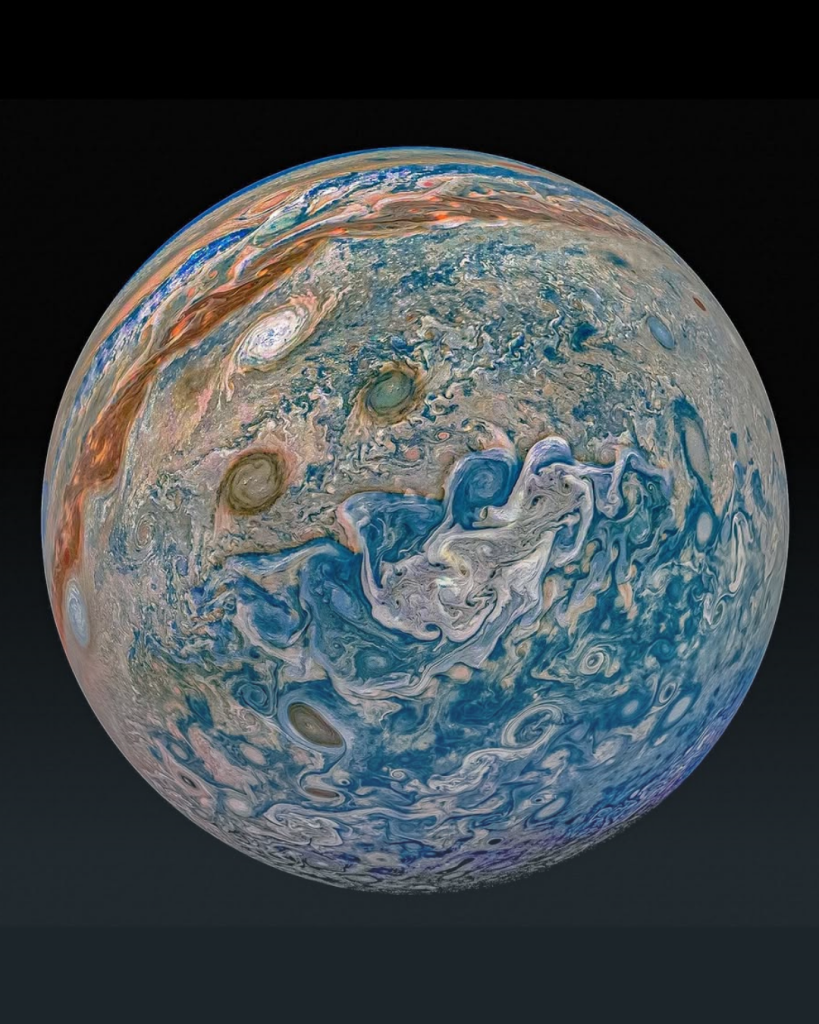
One Juno image of the planet’s southern latitudes, for example, shows a dark circular cyclone approximately 400 kilometers wide, surrounded by smaller swirling structures and cloud bands.
Other Juno observations have captured collections of massive cyclones surrounding Jupiter’s poles, revealing weather systems unlike anything seen on Earth.
The spacecraft’s first close observations of Jupiter’s north pole showed numerous storm systems and atmospheric structures, fundamentally changing scientists’ picture of what the planet’s polar regions look like.
The Images Are Enhanced to Reveal More Detail
The vivid colors visible in many Juno photographs should not necessarily be interpreted as exactly what a person would see with the naked eye.
Many of the most striking images released by NASA are color-enhanced, with processing used to emphasize subtle differences in cloud structure, atmospheric composition and texture.
NASA makes JunoCam’s raw observations publicly available, allowing citizen scientists around the world to process the data and create scientifically useful as well as visually dramatic images.
That public involvement has become an unusual and celebrated element of the Juno mission, with many of the spacecraft’s best-known images processed by astronomy enthusiasts rather than exclusively by NASA scientists.
Juno Is Helping Scientists Understand How Jupiter Formed
The photographs are visually impressive, but Juno’s mission extends far beyond photography.
Scientists are using the spacecraft to investigate Jupiter’s atmosphere, gravity, magnetic field and internal structure in an effort to understand how the giant planet formed and evolved.
Those discoveries matter beyond Jupiter itself. Because Jupiter is by far the largest planet in the solar system and likely played an important role in its early development, understanding its formation could offer clues about the origins of the entire planetary system.
Juno has already shown that Jupiter’s atmospheric bands extend deep below its clouds and that the planet’s enormous magnetic field is even more complex and powerful than scientists once expected.
A Dramatic Portrait of the Solar System’s Largest Planet
More than a decade after it was launched in August 2011, Juno continues to provide scientists and the public with an extraordinary perspective on Jupiter.
Its close-up images reveal a planet that is constantly changing, with immense storms, opposing winds and swirling clouds combining to create an atmosphere that can appear almost like an abstract painting.
NASA’s latest highlighted imagery provides another reminder that beneath Jupiter’s familiar striped appearance lies an extraordinarily turbulent world — and Juno continues to give humanity one of its closest looks yet at the processes shaping the solar system’s largest planet.