
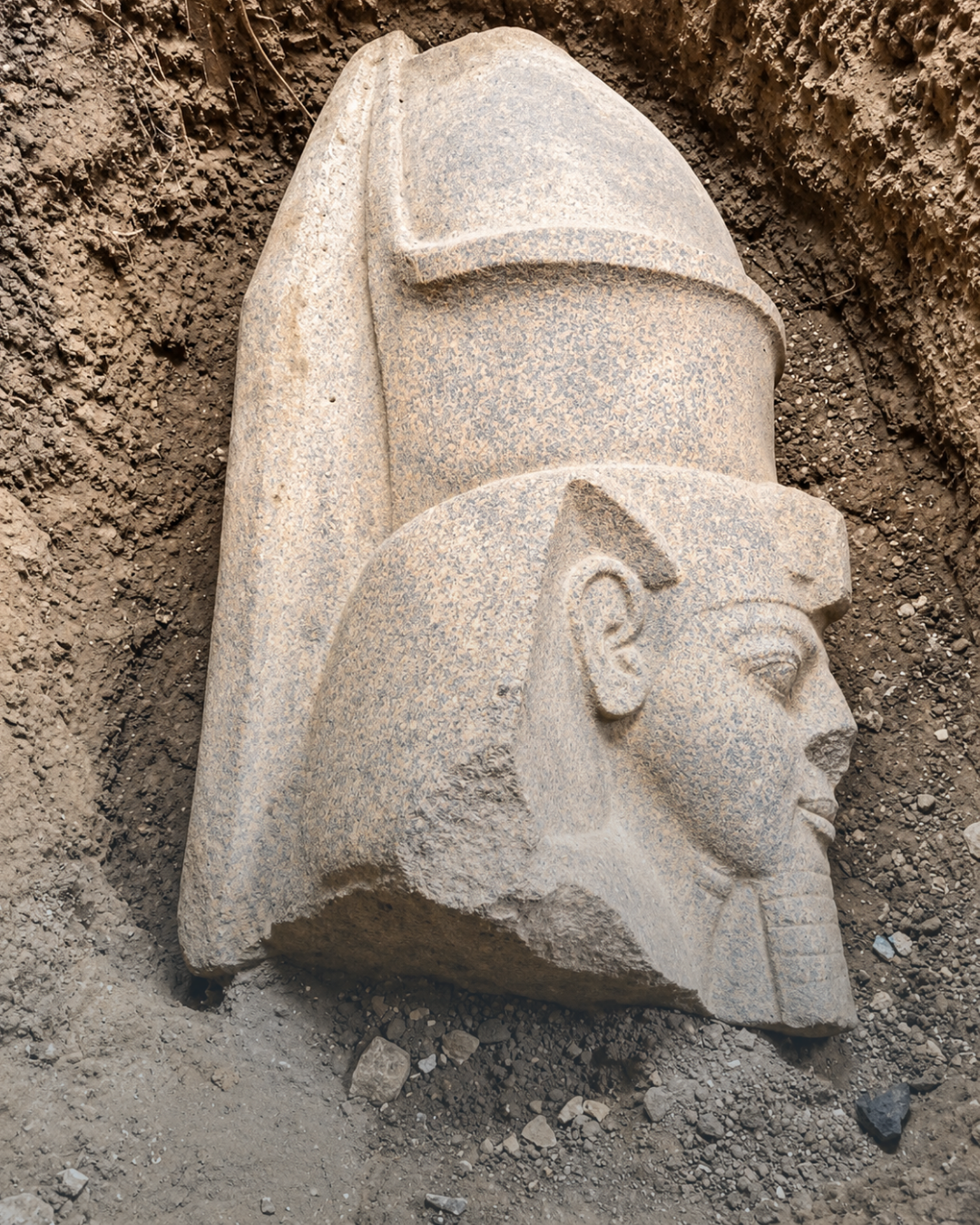
Egyptian archaeologists have uncovered the remains of two colossal royal statues in the Nile Delta, including a massive head belonging to Pharaoh Ramesses II that suggests the original monument stood approximately 8.5 meters tall.
The discovery was announced on October 13, 2026, following rescue excavations in the village of Behbeit El-Hagar in Gharbia Governorate, where a local resident unexpectedly discovered an ancient stone block bearing hieroglyphic inscriptions.
The newly discovered Ramesses II statues include a 1.6-meter-tall royal head, a second large statue fragment measuring 2.4 meters, and a pink granite block inscribed with royal titles.
While the first statue has been identified as Ramesses II, archaeologists believe the second may also depict the 19th Dynasty pharaoh, who ruled ancient Egypt more than 3,200 years ago.
Ramesses II Statues Discovered In Egypt’s Nile Delta
The discovery was made by an Egyptian archaeological mission affiliated with the Supreme Council of Antiquities (SCA) during rescue excavations in Behbeit El-Hagar.
According to Egypt’s Ministry of Tourism and Antiquities, the excavation began after a local resident discovered an inscribed stone block while working on land outside his home.
Recognizing its potential archaeological importance, the resident immediately contacted the local antiquities authorities.
Specialists from the Behbeit El-Hagar Archaeological Inspectorate visited the location and conducted an initial examination, confirming that the stone was an ancient artifact.
Following the inspection, the authorities completed the necessary legal procedures and established a specialized archaeological committee to investigate the surrounding area.
The subsequent excavations uncovered the remains of two enormous royal statues alongside a pink granite block containing hieroglyphic inscriptions.
The discovery has attracted particular attention because of the scale of the statues and their location within one of the Nile Delta’s historically significant archaeological areas.
Egyptian officials believe further investigation could reveal additional information about the region’s religious and architectural development during ancient Egyptian history.
First Ramesses II Statue May Have Stood 8.5 Meters Tall
One of the most significant discoveries is a colossal head depicting King Ramesses II wearing the Double Crown of Upper and Lower Egypt.
The surviving head measures approximately 1.6 meters in height, making it an exceptionally large example of ancient Egyptian royal sculpture.
According to Hisham El-Leithy, Secretary-General of the Supreme Council of Antiquities, the dimensions of the head suggest that the complete statue may originally have stood approximately 8.5 meters tall, including its base.
The Double Crown, also known as the Pschent, symbolized the unification of Upper and Lower Egypt under a single ruler.
Its presence on the statue reflects the royal imagery traditionally associated with Egyptian pharaohs and their authority over the country.
Archaeologists also uncovered part of the statue’s original back pillar.
The surviving section contains an inscription identifying the pharaoh through his Horus name, Hor-Ka-Nakht-Mery-Maat.
The inscription provides important evidence connecting the monument directly to Ramesses II.
Although much of the original sculpture is missing, the preserved head and inscription have allowed archaeologists to identify the ruler and estimate the monument’s original scale.
The discovery adds another example to the extensive collection of monumental statues associated with the reign of Ramesses II.
Second Colossal Statue Believed To Represent Ramesses II
Alongside the first statue, archaeologists uncovered substantial remains of another royal sculpture.
The surviving section measures approximately 2.4 meters in length and includes a head with remarkably well-preserved facial features.
Unlike the first statue, which depicts Ramesses II wearing the Double Crown, the second figure wears the traditional royal nemes headdress.
The nemes was a striped head covering frequently depicted in ancient Egyptian royal sculpture and is strongly associated with pharaonic imagery.
Although the upper part of the headdress is damaged, much of the face remains visible.
The statue is also missing its legs and original base.
According to the Supreme Council of Antiquities, the facial features closely resemble those of the first statue, suggesting that the second sculpture may also represent Ramesses II.
However, its identification has not yet been definitively established.
Further archaeological examination will be necessary to determine whether both statues depict the same ruler and how the monuments were originally connected.
The presence of two substantial royal sculptures in the same excavation area raises additional questions about the site’s historical importance and the original placement of the monuments.
Pink Granite Block Reveals Ancient Royal Titles
The discovery also included a separate block of pink granite measuring approximately 1.3 meters in length.
The block was found about one meter north of the second statue and contains surviving hieroglyphic inscriptions associated with Ramesses II.
According to the archaeological mission, the inscriptions include two royal titles.
The first, Nesu-Bity, translates to “King of Upper and Lower Egypt.”
The second, Sa-Ra, means “Son of Ra,” referring to the ancient Egyptian sun god.
These titles formed part of the traditional royal titulary used by ancient Egyptian pharaohs to express their political authority and divine associations.
The presence of royal inscriptions alongside the statues provides further evidence of the area’s connection to ancient Egyptian kingship.
However, archaeologists have not yet established whether the granite block originally formed part of one of the statues, belonged to another monument, or was associated with a separate architectural structure.
Understanding the relationship between the discovered objects will be an important part of the continuing investigation.
The inscriptions may also help researchers establish the original historical context of the monuments.
Behbeit El-Hagar: An Important Archaeological Site In The Nile Delta
The discovery took place in Behbeit El-Hagar, an archaeological site in Gharbia Governorate that is particularly well known for the remains of a major ancient temple dedicated to the goddess Isis.
Located near the city of Samanoud, the site preserves extensive granite blocks and architectural fragments that reflect its former religious importance.
The temple, commonly known as the Iseum, was one of the most significant centers associated with the worship of Isis in the Nile Delta.
Much of the surviving temple complex dates to the Late Period and Ptolemaic era, several centuries after the reign of Ramesses II.
Its construction is closely associated with the 30th Dynasty pharaoh Nectanebo II, while later Ptolemaic rulers contributed to its decoration and development.
The temple was built using massive granite blocks, many of which remain scattered across the archaeological site.
These architectural remains provide evidence of the scale and complexity of the original religious complex.
Although Behbeit El-Hagar is best known for the Isis temple, the newly discovered royal statues suggest that the area’s archaeological history may extend across additional periods.
However, the statues have not yet been definitively connected to the surviving temple complex.
The current excavations may help clarify whether they belonged to an earlier structure, were relocated in antiquity, or formed part of another monumental setting.
Who Was Ramesses II, The Pharaoh Behind The Discovery?
Ramesses II, also known as Ramesses the Great, was one of the most prominent rulers of ancient Egypt’s New Kingdom.
He ruled during the 19th Dynasty, approximately from 1279 to 1213 BCE, making his reign one of the longest in ancient Egyptian history.
His rule lasted for more than six decades and was marked by extensive construction projects, military campaigns, diplomatic developments, and monumental artistic achievements.
Ramesses II is particularly associated with some of Egypt’s most recognizable ancient monuments.
Among these are the temples of Abu Simbel, where four enormous seated statues of the pharaoh dominate the entrance to the Great Temple.
He also commissioned major building projects at Luxor, Karnak, and other religious centers throughout Egypt.
His reign included the famous Battle of Kadesh against the Hittites, followed years later by a peace agreement that remains one of the best-known diplomatic treaties of the ancient world.
Ramesses II also established Pi-Ramesses as a major royal residence in the eastern Nile Delta.
Throughout his reign, monumental statues played an important role in presenting royal power and reinforcing the pharaoh’s political and religious authority.
The newly uncovered remains at Behbeit El-Hagar fit within this broader tradition of monumental royal sculpture.
However, determining their precise original function will require further archaeological study.
Why The Nile Delta Discovery Is Significant
The discovery of monumental royal sculptures in the Nile Delta contributes to a broader understanding of ancient Egyptian history beyond the country’s most famous archaeological destinations.
While sites such as Luxor, Aswan, and Abu Simbel are internationally recognized for their temples and royal monuments, northern Egypt also played an important role in the development of ancient Egyptian civilization.
The Nile Delta contained major cities, religious centers, trade routes, and administrative settlements throughout different historical periods.
During the New Kingdom, the region was particularly significant because of its strategic position and connections to the eastern Mediterranean and neighboring territories.
Ramesses II maintained a strong presence in northern Egypt, especially through his royal residence at Pi-Ramesses.
The newly discovered statues provide additional physical evidence of royal monumental activity in the wider Delta region.
Their location at Behbeit El-Hagar is particularly interesting because the surviving Isis temple complex is associated mainly with later periods.
The discovery could therefore contribute to a more detailed understanding of the site’s earlier history.
However, archaeologists must first establish the original setting of the statues before drawing conclusions about their purpose or relationship to other structures.
Local Resident Praised For Reporting Archaeological Discovery
An important part of the discovery is the role played by the local resident who first encountered the inscribed granite block.
Rather than attempting to move or retain the artifact, he contacted the relevant archaeological authorities.
His decision allowed specialists to investigate the location and conduct a controlled excavation.
Egypt’s Minister of Tourism and Antiquities, Sherif Fathy, praised the resident for his awareness and responsible handling of the discovery.
The minister emphasized the importance of public participation in protecting archaeological heritage.
He also highlighted the role of local communities in helping authorities identify and preserve historically significant objects.
The resident, Khaled El-Shahat Khalil, was subsequently recognized by the ministry for his actions.
The discovery demonstrates how archaeological findings can emerge unexpectedly during ordinary activities in areas with long histories of human settlement.
It also highlights the importance of reporting potential antiquities to specialists so they can be documented and investigated within their original archaeological context.
In this case, the initial report led directly to the recovery of multiple significant ancient Egyptian artifacts.
Egypt Continues Archaeological Research At Behbeit El-Hagar
Following the announcement, Egyptian authorities confirmed that excavation and archaeological research would continue at Behbeit El-Hagar.
According to Hisham El-Leithy, specialists are examining the relationship between the two statues, the inscribed granite block, and the surrounding archaeological remains.
The research aims to establish a clearer picture of how the monuments were originally arranged and what they reveal about the site’s historical development.
Among the questions still under investigation is whether the statues belonged to a previously unidentified architectural structure.
Archaeologists will also study the physical characteristics of the sculptures, their inscriptions, and the archaeological context in which they were found.
These investigations may help determine whether the monuments were originally erected at Behbeit El-Hagar or moved there during a later historical period.
The Ministry of Tourism and Antiquities has also been examining opportunities to preserve and develop the wider archaeological site.
In 2026, officials reviewed proposals concerning the documentation, conservation, and potential reconstruction of architectural elements from the Temple of Isis.
Such efforts would require extensive research to ensure that any proposed restoration accurately reflects the surviving historical evidence.
The latest statue discovery adds further importance to understanding the site’s archaeological layers before decisions about future development are made.
Egypt’s Nile Delta Continues To Reveal Ancient Treasures
The discovery at Behbeit El-Hagar follows other archaeological investigations that have highlighted the historical importance of Egypt’s northern governorates.
Although the Nile Delta is often associated with agricultural landscapes and modern population centers, the region contains extensive remains from different periods of ancient Egyptian history.
Archaeological work has uncovered military installations, temples, royal inscriptions, settlement remains, and artifacts connected to everyday life.
In September 2026, for example, Egyptian archaeologists announced discoveries at the ancient fortress of Tell Al-Abqain in Beheira Governorate.
Those findings included a horse burial, military-related artifacts, and royal inscriptions associated with Ramesses II and his successor, Merneptah.
Such discoveries provide valuable information about how ancient Egyptian settlements functioned outside the major religious centers of Upper Egypt.
The newly discovered colossal statues add another dimension to this history by highlighting the presence of monumental royal sculpture in the central Nile Delta.
Together, archaeological investigations across the region continue to reveal the complexity of northern Egypt’s ancient history.
What Comes Next For The Newly Discovered Ramesses II Statues?
The immediate priority for archaeologists is to continue documenting and examining the discovered monuments.
Although the first statue has been identified as Ramesses II, the second remains a probable attribution based on its royal appearance and similarity to the first sculpture.
The original dimensions, placement, and architectural context of both monuments are also subjects of ongoing research.
The surviving pieces provide important evidence, but they represent only portions of the original statues.
Additional excavations may help researchers locate further fragments or identify associated structures.
However, the Egyptian authorities have not announced that either statue will be fully reconstructed or placed on public display.
Any future conservation or exhibition plans would depend on the results of archaeological assessments and decisions by the relevant authorities.
For now, the discovery remains an active archaeological investigation with several important questions still unanswered.
Another Major Discovery From Ancient Egypt’s Past
The discovery of two colossal royal statues at Behbeit El-Hagar represents another significant addition to Egypt’s archaeological record.
With one monument positively identified as Ramesses II and the second believed to depict the same pharaoh, the findings provide new evidence of monumental royal sculpture in the Nile Delta.
The discovery also highlights the historical importance of Behbeit El-Hagar, a site already recognized for its extensive remains associated with the goddess Isis.
From the surviving 1.6-meter royal head to the hieroglyphic inscriptions and the second monumental statue, the artifacts offer researchers new material for understanding the area’s ancient past.
As excavations continue, archaeologists hope to establish how the monuments were connected and what their original setting can reveal about the history of the region.
More than 3,200 years after his reign, Ramesses II continues to emerge from Egypt’s archaeological landscape, offering new perspectives on one of the country’s most influential ancient rulers.